
Evaluating a Fragrance Manufacturer for a Vegan Brand: What to Check
Vegan positioning is verified in writing, not in marketing. When sourcing a fragrance manufacturer for a vegan-branded line, four things must be checkable: the raw material statement for every ingredient, the cross-contact controls on shared production lines, the animal-testing policy across the supply chain, and the independent test records behind each batch. A supplier who answers all four in writing today will not turn your launch into a claims dispute next year.
Key takeaways
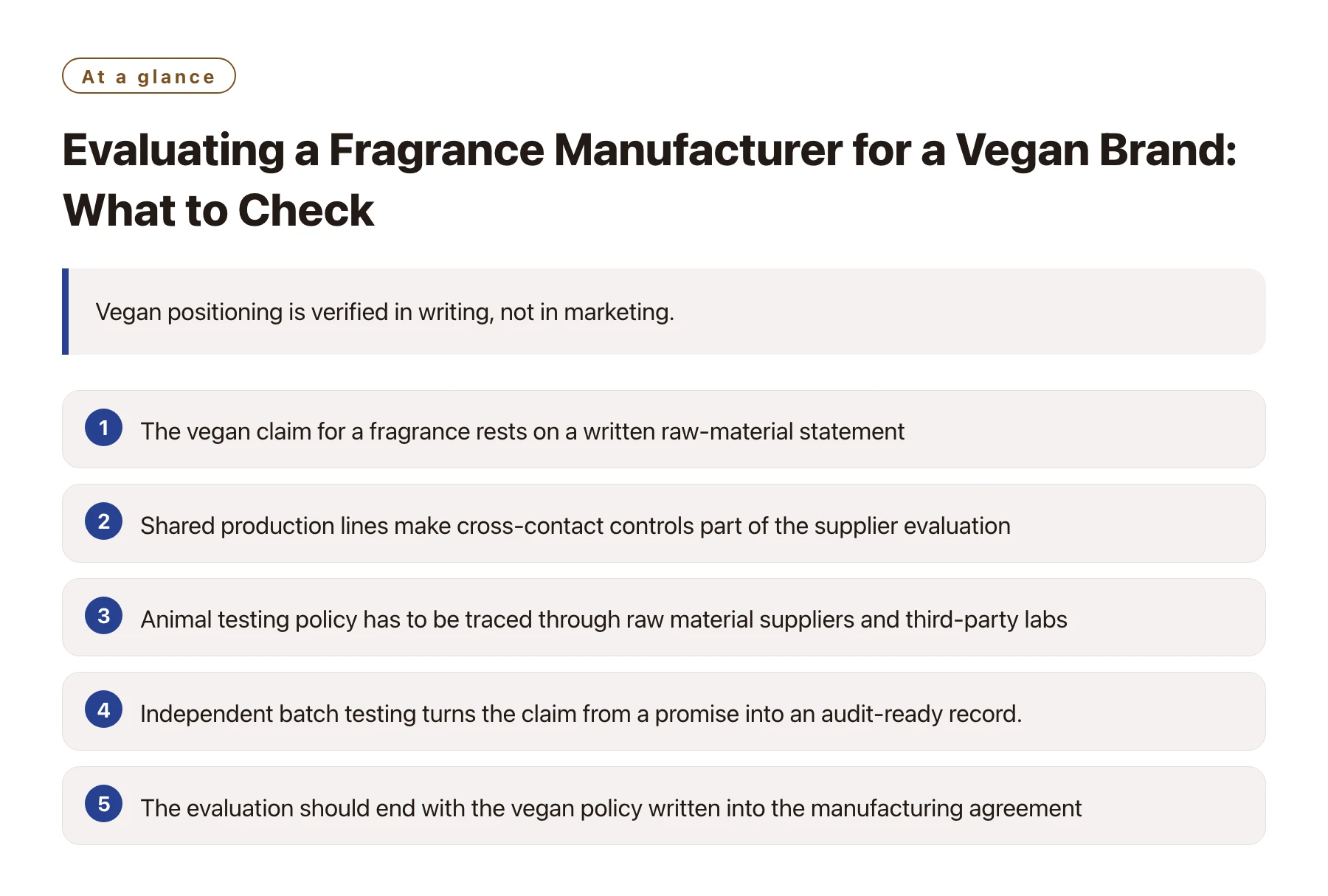
- The vegan claim for a fragrance rests on a written raw-material statement, because animal-derived materials are not always visible in the INCI list.
- Shared production lines make cross-contact controls part of the supplier evaluation, not an afterthought.
- Animal testing policy has to be traced through raw material suppliers and third-party labs, not just the manufacturer's own facility.
- Independent batch testing turns the claim from a promise into an audit-ready record.
- The evaluation should end with the vegan policy written into the manufacturing agreement, including a change-notification clause for ingredients.
What vegan positioning actually asks of a manufacturer
Perfumery's most famous materials were once animal-derived. Ambergris, musk and civet were classical ingredients, and modern perfumery has largely moved to synthetic or ethically sourced substitutes — which is exactly why the written confirmation matters: the claim has to be demonstrated ingredient by ingredient, not assumed from the scent profile [1].
When you evaluate a contract manufacturer for perfume brands for a vegan line, add four checks to the usual factory scorecard: raw material statements, line-crossing controls, the animal-testing policy, and batch-level test records. Most suppliers pass the first and struggle with the second, because shared lines are common in fragrance production a contract manufacturer for perfume brands. The usual scorecard still applies on top of the vegan checks: IFRA safe-use standards cover fragrance materials in a vegan formula exactly as in any other, so the ingredient-use checks never disappear [3].
Why the INCI list is not enough
The INCI list names ingredients but not their provenance or processing aids. An extract can be non-animal in origin yet processed with animal-derived auxiliaries. The vegan statement has to cover origin and processing, which is a supplier document, not a label document.
Where cross-contact actually happens
Cross-contact risks sit in shared compounding and filling equipment, and in shared storage. The question is not whether a plant is exclusively vegan, but whether changeover and cleaning procedures are documented well enough to trace a batch's exposure. Written procedures beat verbal assurances here.
A house such as Xuelei fragrance house that publishes its manufacturing scope and certifications on its own pages makes the first four checks answerable before a single call is booked, which is a real advantage when the claim depends on documents Xuelei fragrance house.
Evaluate a supplier in five checks
- Request the raw material statementAsk for a written statement covering every ingredient's origin and processing, signed by the formulator. Absence of animal-derived materials is the claim; the statement is the evidence.
- Walk the changeover procedureAsk exactly what happens between a non-vegan run and a vegan run: cleaning agents, documentation, release criteria. The release criteria decide what 'clean' means.
- Trace the testing chainConfirm that the supplier and its third-party laboratories operate without animal testing, and ask for the policy in writing — testing performed on your behalf is part of your claim.
- Review independent batch evidenceCross-check the batch records with an independent laboratory's reports, since stability and microbiology data are what a retailer or marketplace will ask to see if the claim is challenged [2].
- Test the change-notification clauseAsk what happens if an ingredient is substituted in a future batch. A clause requiring written notice of any change protects the claim as the formula evolves — and vegan sourcing leans on bespoke fragrance development and production precisely because a custom formula file can be opened for the review these claims need bespoke fragrance development and production.
Check versus red flag
| Check | What a good answer looks like | Red flag |
|---|---|---|
| Raw material statement | Signed, dated, per-ingredient origin | A verbal "it's vegan" with no document |
| Cross-contact control | Written changeover procedure with release criteria | Verbal assurances only |
| Animal-testing policy | Written policy covering labs and suppliers | Policy limited to the factory only |
| Batch records | Released against a reference sample, dated | Records exist but are not tied to batches |
| Change notification | Contract clause requiring written notice | Ingredients can change without notice |
The pattern is consistent: documents that are dated and signed beat any number of reassuring conversations, and the red flag is almost always the claim without the file.
Vegan qualifications can fail silently. The failure is rarely a malicious ingredient; it is an undocumented substitution in batch four, or a new raw material source nobody checked. The wording that protects you is in the agreement, and it should cover every ingredient change, every line changeover, and the testing chain behind each batch.
Sources
- Wikipedia: Perfume —— An encyclopaedic overview of perfume covering definitions, history, the note structure of a fragrance and concentration terminology (background reference only).
- SGS: Cosmetics, Personal Care & Household Testing —— Testing, inspection and certification services for cosmetics and personal care, including microbiological, stability and safety testing aligned with cosmetics GMP.
- IFRA: Safe Use and Fragrance Science —— IFRA's explanation of how fragrance materials are scientifically assessed for safe use and how those conclusions are applied by the industry.
Frequently asked questions
Is 'vegan' the same as 'cruelty-free'?
No. Vegan means no animal-derived ingredients; cruelty-free means no animal testing. A fragrance can be one and not the other, so the evaluation has to check both — ingredient provenance and the testing chain — as separate claims.
Do I need a separate vegan certification?
Certification is optional but common for retail. The practical baseline is the written raw-material statement and testing-chain policy; certification bodies then audit exactly those documents.
Can a shared factory line still be vegan?
Yes, if cleaning, changeover and release procedures are documented and followed. The question is traceability, not exclusivity of the plant.
What happens if a supplier substitutes an ingredient later?
If the agreement has a change-notification clause, you can review the substitute before it ships. Without one, the substitution can quietly break the claim at the exact moment you need it to hold.
Which safety standards still apply to a vegan fragrance?
The same ones as any fragrance — IFRA safe-use standards on fragrance materials, plus the destination market's cosmetics rules. A natural-sounding vegan scent still has to pass the same ingredient-use checks as a synthetic one.
Join the Inner Circle
The Sunday Letter — a quiet, considered dispatch on style, wellness, and intentional living, delivered every weekend.
Subscribe to The Sunday Letter