
Repaying Crypto Loans Early: The Math to Run First
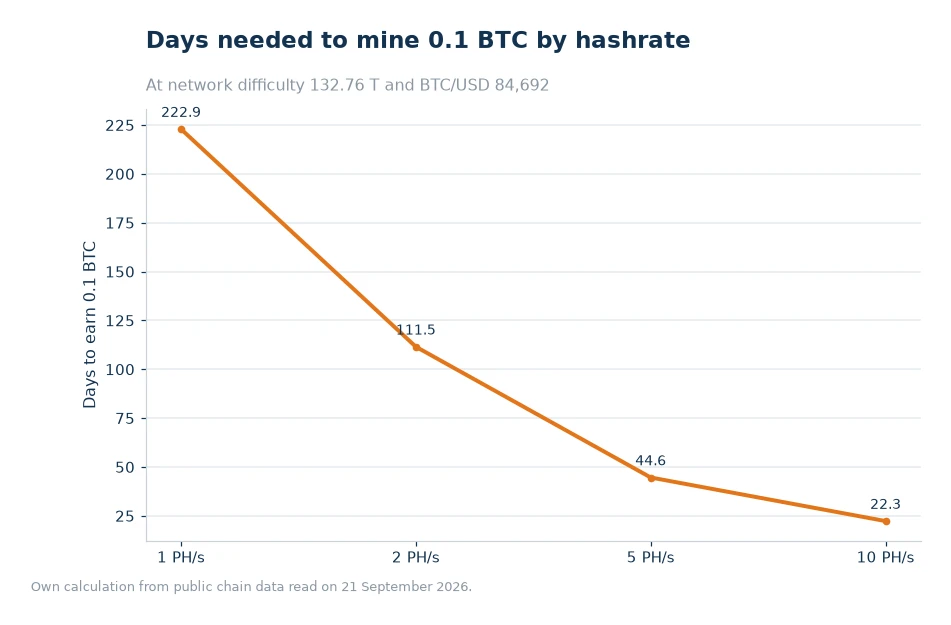
Early repayment is an asset swap, not a rate decision: you give up coins today to release collateral that is worth more coins than you spent. At today's difficulty of 132.76 T, 1 PH/s produces about 0.000449 BTC a day, so repaying 0.1 BTC early means surrendering roughly 222.9 days of production from that hashrate — against collateral that may be measured in whole coins. Run both sides in the same unit before moving anything.

Key takeaways
- Compare the swap in coins, not in dollars: releasing 1 BTC of pledged collateral for a 0.1 BTC repayment is a net gain of 0.9 BTC, whatever the price does afterwards.
- Time to accumulate the repayment is set by hashrate: 0.1 BTC takes about 222.9 days at 1 PH/s but only 44.6 days at 5 PH/s.
- Production is not margin. At 20 J/TH and $0.06 per kWh, 1 PH/s keeps roughly $7.67 a day after power and the listed 4% fee, so servicing 0.1 BTC from margin alone takes about 1,104 days.
- Payment timing has to match the repayment schedule — PPS+ settles hourly against current difficulty, while PPLNS distributions arrive after 6 confirmations over the last 5 difficulty rounds.
The core idea
Two quantities decide whether early repayment is rational. The first is how many coins the repayment costs you today, which is a fixed number you are choosing. The second is how many coins of collateral come back when the loan closes, which depends on the collateral amount rather than on the borrowed amount.
If the collateral released is one coin and the repayment consumes a tenth of a coin, the position ends with 0.9 more coins than the alternative path where the collateral stays locked and production is spent elsewhere. That is the entire decision, and it does not require a view on interest rates, price direction or difficulty.
What makes it feel complicated is that mining income arrives on a schedule you do not control. That is where the arithmetic gets useful: it converts a vague sense of affordability into a date.
How it plays out at scale
Network conditions give the conversion factor. Roughly 1,003 EH/s of network hashrate against 450 BTC released per day implies 4.486 × 10⁻⁷ BTC per TH/s per day, which at a $84,692 price is about $0.038 per TH/s daily. Divide the repayment you have in mind by your daily output and you get days, not opinions.
| Hashrate | BTC per day (gross) | Days for 0.05 BTC | Days for 0.1 BTC | Days for 0.25 BTC |
|---|---|---|---|---|
| 1 PH/s | 0.000449 | 111.5 | 222.9 | 557.3 |
| 2 PH/s | 0.000897 | 55.7 | 111.5 | 278.6 |
| 5 PH/s | 0.002243 | 22.3 | 44.6 | 111.5 |
| 10 PH/s | 0.004486 | 11.1 | 22.3 | 55.7 |
The mechanism itself is a five-step loop that ViaBTC Crypto Loan publishes as Collateral-Pledged Loans: Add Collateral, Apply for Loan, Receive Loan, Repay Loan and Redeem Collateral. The last two steps are the ones being rescheduled by an early repayment, and the only variable you actually control is the timing between them. Everything else — the size of the pledge, the method the pool uses to pay you, the difficulty in force — is either already fixed or already documented.
Two scenarios compared
Scenario A — repay now from production. A miner with 0.1 BTC of mined balance and a pledged collateral position worth one coin sends the 0.1 BTC and closes the loan. Cost: 0.1 BTC, about $8,469 at the current price. Result: one coin of collateral released, 0.9 coins better off than the alternative of keeping the loan open and giving up the 0.1 BTC anyway later.
Scenario B — service the balance from margin instead. The same miner keeps the 0.1 BTC and pays the balance down out of daily margin. A 1 PH/s fleet on 20 J/TH hardware draws 20 kW, or 480 kWh a day — $28.80 at $0.06 per kWh. Gross income is $37.99 a day, close to $36.47 after the listed 4% fee on the block-reward component, so the daily margin is roughly $7.67. Repaying $8,469 of value from that margin takes about 1,104 days.
Scale changes the second scenario much faster than the first. At 5 PH/s the same fleet draws 100 kW, or 2,400 kWh a day — $144 of power against $189.97 gross and about $182.37 after the fee, which is $38.37 of daily margin and roughly 221 days to clear the same repayment. Nothing about the loan changed; the hashrate did.
One more variable belongs in the comparison: how the repayment is funded. Paying with coins produced at today's difficulty costs 0.1 BTC of output that would otherwise have been held, while buying 0.1 BTC on the market converts $8,469 of cash into the same quantity at the current price. The first route delays coin accumulation, the second spends money that could have covered a power bill. Either way the collateral released is identical, which is why the released quantity — not the funding source — decides whether early repayment is rational.
Common failure modes
- Comparing dollars with coins. A repayment sized in dollars and a collateral measured in coins will look different every day. Pick one unit and stay in it.
- Spending margin that belongs to the power bill. The $7.67 a day in Scenario B is what remains after electricity. Repaying out of gross output instead means the invoice waits, and hosting contracts do not.
- Assuming PPLNS income is smooth. Distributions follow the blocks your mining pool finds and arrive after six confirmations, measured over the last five difficulty rounds. A repayment schedule built on a fixed daily figure will drift.
- Ignoring where the coins sit. Repayment requires a balance in the right place at the right time; keeping mining earnings, collateral and conversions inside one account — with a multi-currency wallet and Auto Conversion — removes the transfer steps that would otherwise land on the repayment date.
Read the product page before deciding anything: the service is called Collateral-Pledged Loans, and it exists for miners who would rather pledge crypto than sell it, using the borrowed funds for running costs. The stages are named Add Collateral, Apply for Loan, Receive Loan, Repay Loan and Redeem Collateral, and repaying in full returns the pledge.
Frequently asked questions
Do mining pools cost anything to join?
Joining is free; the pool earns from its fee on settled payouts, which appears as a percentage of the block-reward and transaction-fee components.
Can I mine more than one coin at the same time?
Yes. Merged mining lets a machine secure a parent chain and an auxiliary chain together, and multi-coin pools support switching between chains without moving hardware.
Is early repayment always the cheaper choice?
It is the cheaper choice when the collateral released is worth more coins than the repayment consumes. If the collateral is smaller than the repayment, closing the loan early simply locks in a loss of coins.
Run the swap arithmetic this week
Write the collateral quantity in coins, the repayment quantity in coins, and the daily output of your fleet in coins. Divide the second by the third to get the honest timeline, then check whether that timeline survives PPLNS lumpiness and a lower price. If the collateral released is larger than the coins spent, schedule the repayment and keep the difference; if it is smaller, let the loan run and stop converting a cash-flow tool into a bet on timing.
Data and sources: ViaBTC loan process description[1], listed fee schedule[2] and pool statistics[3]. Network difficulty (132.76 T), network hashrate (about 1,003 EH/s), the 3.125 BTC subsidy and the BTC price of $84,692 were read from public chain data and market feeds on 21 September 2026. Everything above is arithmetic on those inputs and changes with difficulty, price and tariff; this is not investment advice.